How to end a free walking tour (and why it decides your tips)
The final 10 minutes of a free walking tour decide a disproportionate share of your earnings. How to structure the ending to create the right moment.
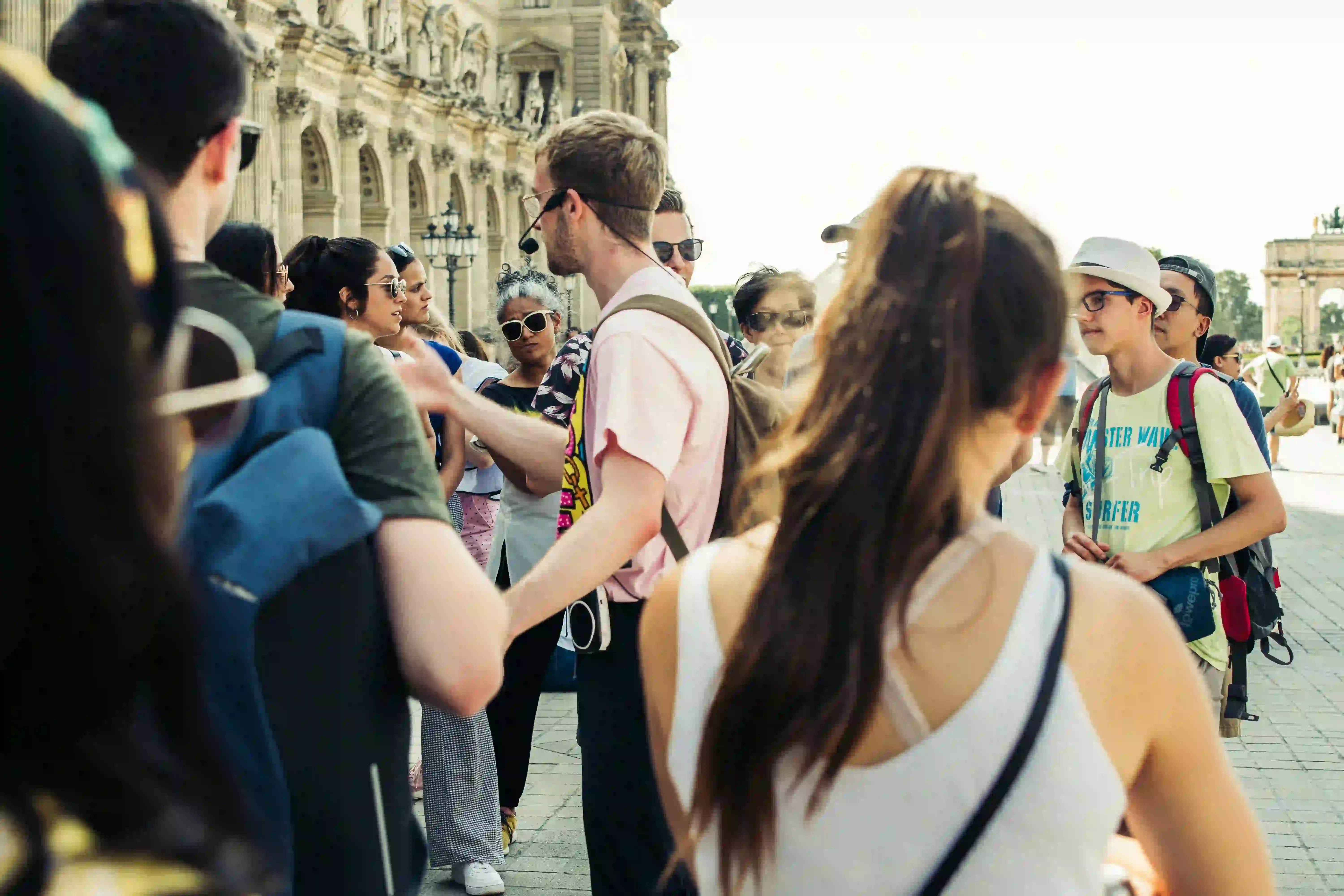
I watched a guide in Budapest end his tour at a mediocre spot. A street corner with traffic noise, partly in shade, the group already restless and half-turned toward the nearest metro sign. He said his tip speech in under ten seconds and looked at his watch while he said it. He got €3 from 18 people.
The next week I watched the same guide end a different tour on a terrace overlooking the Danube, sunset behind him, the group visibly emotional after a story he’d told two minutes earlier about a family he’d met while researching the city. He got €240 from 20 people.
The difference was not the tour. It was not his script, not his energy on that particular afternoon, not the demographics of the group. It was the ending. Specifically: where it happened, what immediately preceded the ask, and how long he stayed afterward.
This article is not about the words of the tip speech — those are covered in detail in how to ask for tips without feeling awkward. This is about the structural decisions around the final ten minutes that most guides treat as an afterthought and that are, in fact, the single highest-leverage thing you control.
The final stop is a design decision
Most guides pick their final stop based on what is interesting, what is nearby, or what is convenient for group dispersal. Those are the wrong criteria.
The final stop has one job: to create conditions where guests feel something and want to linger. Everything else flows from that. A stop near a metro entrance fails this test not because the building is uninteresting, but because the environment is working against you. Traffic noise makes it hard to hear your story. People checking transport apps are already mentally gone. The physical pressure of crowds and buses makes the group want to disperse the moment you stop talking.
The ideal final stop has four qualities. It gives the group somewhere to gather without blocking foot traffic. It offers a view, a sense of elevation, or a feeling of arrival — a terrace, a hilltop, a large open square, a bridge. It is quiet enough that you can be heard without raising your voice. And it has no obvious exit cue: no metro sign, no bus shelter, no taxi rank pulling at people’s attention.
In practice this means: a viewpoint above the city, a riverside terrace, a historic courtyard, a cathedral square that is pedestrianized at one end. The group should feel they have arrived somewhere, not that they are standing on a random corner waiting for you to finish.
One practical note: visit your candidate final stops at the time of day you run your tours. A square that is beautiful at noon may be in full shade and covered in delivery trucks at four in the afternoon. A riverside terrace that is quiet on a Wednesday may be packed with after-work drinkers on a Friday. The stop has to work at the actual time you need it, on the actual days you run.
The final story: what it has to do
The story you tell immediately before the tip ask is the most important story of the tour. Not because it needs to be the most historically significant or the most informative — but because it sets the emotional state your guests will be in when you ask.
The final story should do one of three things: make the group laugh genuinely, move them unexpectedly, or surprise them with something they could not have anticipated. What it should not do is provide more information. By the time you reach your final stop, guests have been absorbing history and context for two hours. One more fact does not land the same way. What lands is a story that feels personal, that reveals something about you or about the city that is not in any guidebook, or that connects to something the group experienced together during the walk.
The emotional peak of the final story is what opens people up. Generosity — with money, with reviews, with warmth — flows most naturally from a state of genuine feeling, not from a state of intellectual appreciation. Guests who are still laughing or slightly moved when you begin your tip ask are in a completely different psychological state from guests who are politely attentive.
Keep the final story short — four to six minutes — and end it with a beat of silence before you move into the close. That pause is where the emotion settles. Do not rush it. Do not bridge directly into the tip speech. Let the story land, wait a moment, and then begin.
Holding the group through the dispersal moment
There is a specific challenge at the end of every tour that guides learn to recognize and dread: the dispersal impulse. At some point in the final few minutes, a threshold passes and the group begins to psychologically check out. Bags are adjusted. Phones are checked. People glance at each other in the way that signals “are we done?”
If you hit the dispersal moment before the tip ask, you have lost the group. You are speaking to people who are already somewhere else.
The way to prevent dispersal is through physical positioning and direct engagement. Position yourself so that the group gathers around you, not in a line. If you are at the edge of a terrace with a view behind you, people will face you to see the view and face you to hear the story. That geometry keeps them together. A stop where you are standing in front of a building and the group stretches out down a sidewalk gives the edges of the group no reason to stay.
If you can see dispersal beginning — bags being picked up, sideways conversations starting — you have one tool: direct, warm, specific eye contact with the people on the periphery. Not a command, not a pause in your story, just a look that says “I see you, this is for you too.” It sounds small. It works.
The second tool is a question. Asking the group something, anything, snaps people back from wherever they have gone. “Has anyone been here before today?” or “What was the thing that surprised you most?” These questions are not there for the answers. They are there to re-establish that this is a group, that people are listening, that what comes next is worth waiting for.
The tip sequence
Once you have the group’s attention at the emotional peak of the final story, the close itself can be relatively simple. Here is the sequence that works:
Genuine thanks first. Not a formula. One or two sentences that feel specific to this group on this day. If someone asked a great question, mention it. If the group was unusually engaged, say so. People can tell the difference between a scripted thank-you and a real one.
Context, briefly. One sentence on why tips matter: “This is a tip-based tour — your contribution is how I earn my living, and it’s how you tell me how I did today.”
Anchor the amount. Name a number. “Most guests leave around ten to fifteen euros.” Say it without apology, without hedging. This is not a demand; it is information. Guests need a reference point and they will use the one you give them.
Introduce the cashless option. Hold up your QR code at chest height and say: “If you prefer to pay by phone, just scan this — it takes about ten seconds.” Then stop talking and let the moment happen.
The first tipper. The moment the first person reaches for their wallet, make brief, genuine eye contact with them and say thank you — quietly, to them specifically. This is not a performance. It is a real acknowledgment that matters, and it also signals to everyone else in the group that the tipping has started, which makes it much easier for others to follow.
Invite people to stay. “I’m going to be here for a few minutes if anyone has questions or wants a recommendation for lunch.” This keeps the group from evaporating the second the formal moment ends.
After the ask: the five minutes that generate extra tips
Most guides deliver their speech, collect what they collect, and then either start moving immediately or stand awkwardly until the last guest leaves. Both of these are mistakes.
Staying present for five to ten minutes after the tip ask generates a meaningful portion of extra earnings. Here is why: a portion of every group is genuinely undecided at the moment of the ask. They enjoyed the tour, they are thinking about tipping, but they have not committed. A two-minute personal conversation — their question answered warmly, a restaurant recommendation given specifically, a genuine moment of human connection — tips them from “maybe” to “yes.” And often to more than they were originally considering. The 15 proven tactics for increasing tips covers this same dynamic in depth, including how to handle the undecided portion of your group systematically rather than by chance.
The guests who were already going to tip are not made less generous by you staying to talk. The guests who were undecided are made more generous. The guests who were never going to tip are not affected either way. The math always points toward staying.
Stay visible. Stay warm. Move around the group, not away from it. This is the part of the tour that most guides abandon because it feels informal and uncertain after the structure of the walk. Treat it as the close of the close.
Restaurant recommendations as the final act of value
There is a specific tool that works unusually well in the final minutes: the restaurant or bar recommendation.
When you give someone a genuinely useful, specific, personal recommendation — not “there are some nice places near the main square” but “walk two blocks down this street, turn left, there is a place called X, ask for a table in the back room, order the Y” — you have done something valuable that they did not expect and cannot easily replicate from a phone. You have used local knowledge on their behalf.
This triggers reciprocity in a way that nothing else in the closing sequence does. The guest who just received information they will actually use feels a debt of genuine gratitude, not just appreciation for a good tour. That specific feeling of “you gave me something” is what causes people to reach back into their wallet for more.
Keep two or three recommendations ready at all times — different types, different price points — so you can match the recommendation to the person. A family with young children gets a different answer than a pair of twenty-somethings who mentioned they like natural wine. The specificity is the whole point.
Asking for a review
The same moment that works for the tip ask works for the review request. Guests who are emotionally at their peak, who have just experienced the tour at its best, are also at their most willing to write. A review request made the next day by email converts at a fraction of the rate of one made in person, in the moment. The full picture of how to get more Google reviews as a tour guide — including the long-term impact on bookings and group quality — is worth reading alongside this closing structure.
The simplest way to do it: once the tip ask is made and the first few people have responded, hold up your phone and say: “If you have a moment and enjoyed today, a Google review means the world to me — it’s what helps other travellers find the tour.” Then show the QR code or link, or simply say “just search [your tour name] on Google.” Do not beg for it. Do not frame it as a favour. Frame it as what it is: the way the internet finds good tours.
Critically: ask for the review and the tip at the same moment or in direct sequence. Splitting them into different moments — the tip ask at the end, the review request an hour later by text — means you are asking twice for two separate things, both of which require effort from the guest. Together, in the same emotional moment, they feel like one gesture of appreciation. Separately, they feel like two solicitations.
Putting the structure together
The final ten minutes of a free walking tour are not an appendix to the real tour. They are the culmination of everything that came before them, and they have a disproportionate influence on what you earn and what gets written about you.
The decisions that matter most are made before the tour starts: which stop to end on, which story to tell last, how to physically position the group. The words of the tip ask are almost secondary to those structural choices. A mediocre closing speech delivered at the right stop after the right story will outperform a perfect closing speech delivered on a traffic island after a forgettable anecdote.
The guide in Budapest did not suddenly become a better guide between those two tours. He had the same knowledge, the same energy, the same city. What he did differently was choose a spot that created a moment, tell a story that moved people, and stay long enough afterward for the generosity that the tour had earned to have somewhere to go.
That is the whole model. Design the ending, not just the route.
Frequently asked questions
What should the final stop of a free walking tour look like?
An elevated spot with a view, a beautiful square, or a quiet terrace — somewhere the group can gather without traffic noise or pedestrian pressure. Avoid ending near metro entrances, bus stops or train stations: guests already have half their mind on transport.
How long should the tip ask take?
Between 60 and 90 seconds. Any shorter and it feels rushed and apologetic. Any longer and it starts to feel like a sales pitch. The sequence is: genuine thanks, brief context (this is how you earn), anchor amount, cashless option, invitation to stay for a moment.
When should I ask for a review?
At the same moment as the tip ask, or immediately after. Guests are emotionally at their peak right after the final story. That generosity applies to both money and words. A review request that comes a day later by email converts at a fraction of the rate of one made in person, in the moment.
Should I stay after the tour or leave quickly?
Stay for at least 5-10 minutes. People who were hesitating often decide to give more after a 2-minute personal conversation. And guests who felt a genuine human connection with the guide are the ones who write the best reviews.