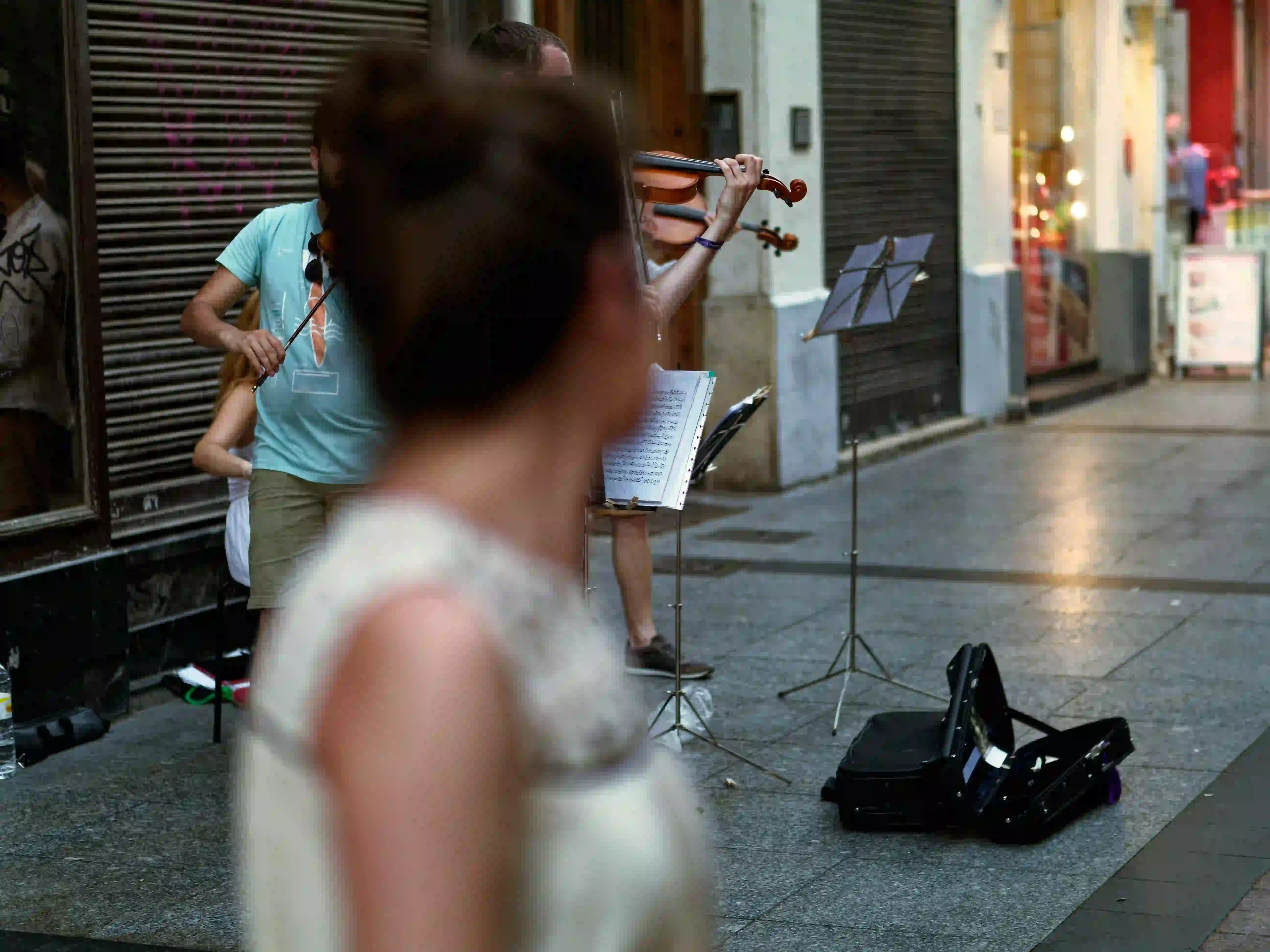
Busking income: how much can you really make?
Honest figures on busking income across European cities, the variables that create the wide range, and what the real weekly and monthly picture looks like.

The first time someone told me a busker could make €500 in a day, I didn’t believe it. The second time, I was standing on a London street watching a violinist with a case full of notes — £20s tucked under a layer of coins, a small crowd three people deep, and a hat that had clearly not started empty. That second moment shifted something. I stopped thinking about busking as a romantic fallback and started thinking about it as a business with real mechanics.
The reality is more nuanced than either the romantic poverty myth or the viral success story. And knowing the real numbers — the actual range, the variables, the weekly picture — changes how you plan around street performance, whether it is your primary income or part of a broader creative career.
The honest range: from €10 to €500 in a single day
The range really is that wide, and that is not a hedge — it reflects genuinely different conditions.
A beginner playing acoustic guitar in a quiet side street on a Tuesday morning in November might clear €10 in two hours. A classically trained saxophonist working a permitted spot at a major London train station on a Saturday afternoon in July might clear €400. Both are busking. The conditions that separate them are not mysterious — they are learnable and manageable.
The most useful framing is not “what do buskers make?” but “what does busking pay in situation X?” The situation is almost everything.
The variables that actually drive income
Location is the single largest factor, and it operates at two levels: the city and the specific spot within that city.
At the city level, tourist volume, average tourist spending power and local tipping culture all feed into how much ends up in your case or on your QR code. At the spot level, the question is footfall and dwell time. A busy pedestrian crossing generates thousands of passes an hour, but most people don’t stop. A narrow street that funnels people past a natural chokepoint — the bottom of a staircase, a bridge with no room to cross quickly, the entrance to a market — keeps people in earshot longer. Dwell time converts footfall into income. The cashless revenue you lose without a digital tip option compounds this further — high-footfall spots in tourist cities have an increasingly cashless audience.
Weather has a larger effect than most people expect before they experience it. Rain does not just reduce crowds — it changes crowd psychology entirely. People in rain are focused on getting somewhere dry, not on pausing to listen. A warm, dry Saturday afternoon in a tourist area can yield five to ten times what a rainy weekday does at the same spot.
Time of day and day of week matter significantly. Saturday and Sunday afternoons are the peak window in most European cities. Lunch hours on weekdays can work in business-heavy areas. Early mornings and Monday mornings are generally the lowest earners. Friday evenings near bars and restaurants can be strong for the right genre.
Season amplifies everything else. High tourist season in a major city — roughly June through August in northern Europe, extended into September and October in Mediterranean cities — is when the real money is made. Winter busking in northern European cities is a different economic proposition entirely.
Genre and repertoire affect both tip rates and crowd formation. Recognisable music with emotional resonance tends to build larger crowds faster than technically impressive but unfamiliar material. This is not a criticism — it is a fact that experienced buskers learn quickly and factor into their setlist choices. A few crowd-drawing pieces early in a set, followed by more personal material once the crowd has formed, is a common structure.
The performer’s skill and energy matter, but perhaps differently than you expect. Raw technical ability is less important than stage presence and the capacity to make strangers feel welcome to stop. A confident, warm performer who makes eye contact and shows they are glad people stopped will consistently outperform a technically superior musician who treats the sidewalk audience as an interruption.
Performance length is a practical variable. Short, punchy sets that end with a clear invitation to give — and then reset for the next passing wave — often outperform continuous playing where the tipping moment never arrives.
City comparisons: what performers report
These figures are estimates drawn from what performers describe in forums, conversations and interviews — they should be treated as indicative rather than precise, and a great deal depends on the specific spot and the individual performer.
London is consistently reported as the strongest market. Permitted spots in major stations (Waterloo, King’s Cross, Liverpool Street) and key outdoor zones can yield £80–200 on a good day, with strong days at prime spots reaching considerably more. The licensing system means competition for top spots is real.
Paris has a split market. Metro Musiciens du Métro permit holders in major stations (Châtelet, Saint-Lazare, Montparnasse) report €80–200 on strong days. Street pitches outside the RATP system are more variable, and enforcement in central tourist zones is inconsistent.
Amsterdam benefits from high tourist density in a compact city. The city-centre spots around the Leidseplein, Rembrandtplein and along the main canal routes can yield €60–150 on peak days.
Vienna has an active busking culture and high tourist spending. The pedestrian zones around the first district and near the Stephansplatz are strong earning spots. Performers report €50–130 on good days.
Prague generates high foot traffic through its historical centre but per-person spending on tips tends to be lower than in western European cities. Performers report €30–80 on typical days, with higher outliers during peak summer season.
Barcelona is high-traffic but highly variable. Las Ramblas is heavily regulated and the permit system is competitive. Side streets off the tourist zones can be productive. Reports cluster around €40–100 on good days, with significant variation by zone.
Rome has complex regulation — the rules vary by district and enforcement is inconsistent. Popular tourist zones like the area near the Pantheon or Piazza Navona can be productive in tourist season. Reports suggest €40–90 on typical days.
Best and worst scenarios
The best-case scenario is roughly: a permitted pitch at a major transit hub or prime tourist street, Saturday afternoon, warm and sunny weather, peak tourist season, an experienced performer with strong crowd-building material, and a mix of physical and contactless collection. In these conditions, €200–400 is achievable for a full session, and exceptional days at exceptional spots can go beyond that.
The worst-case scenario is the inverse: a Tuesday morning in January, overcast and cold, a less-trafficked location, a performer in their first season who is still figuring out which material builds crowds. In these conditions, €10–25 for a morning session is realistic.
Most working days fall somewhere in the middle.
Passive income triggered by live performance
This is the part that most income estimates ignore, and it compounds over time.
A portion of every crowd you play to will follow you somewhere — your Instagram, your YouTube channel, a Spotify profile linked via a business card or a QR code on your case. This matters not because social media income from a modest following is large (it usually is not, initially), but because it compounds. A YouTube video that captures a good street performance can accumulate views long after the day it was filmed. Music sales and streaming revenue triggered by live exposure add a small but real fraction to the total picture, and for performers who are active on social platforms, that fraction grows.
The most efficient deployment of this: a QR code in your case that links to a short page with your tipping link, Spotify profile and social channels simultaneously. Capture the audience that has their phone out anyway. A step-by-step guide to setting up a QR code for tips covers the practical setup in under an afternoon.
The weekly and monthly reality
Most working buskers do not perform seven days a week. Weather, licensing, physical stamina and life logistics typically mean three to five active performance days per week in a good season.
At a conservative estimate — four days per week, average earnings of €60/day — that is €240/week, roughly €960/month from live performance. At a stronger estimate — five days per week at €100/day in peak season — that is €2,000/month. These are not guaranteed figures; they represent a realistic range for an established performer in a reasonable location.
The seasonal nature of income is the hardest part of the financial picture. Summer income needs to carry winter, and the most financially sustainable buskers build that into their planning. Three or four strong summer months can fund a more modest-volume winter if managed carefully. The broader question of how much to tip a street performer — which many audiences genuinely wonder about — is also worth understanding from the performer’s side, since it shapes realistic expectations for per-person income.
Tax: the short version
Busking income is taxable income. The fact that you receive it in cash, or via a QR code, does not exempt it. Most countries require self-employed performers to register as sole traders or equivalent and to report earnings. Income that goes unreported is a legal and financial risk, not a loophole.
The administrative overhead is real but manageable. A dedicated article on tax for street performers covers this in more detail — the short version is: register, track your income, keep receipts for your equipment costs (they are usually deductible), and file.
The cashless effect on income
Adding a QR code for contactless tipping is one of the most concrete income improvements available to street performers. The mechanism is simple: a growing proportion of people — especially tourists in major European cities — carry little or no physical cash. If you only accept physical tips, you lose all of them.
Performers who have added contactless tipping consistently report increases in the range of 20–40% over baseline, once the QR code is properly positioned, sized and visible. That figure varies by location and audience — younger, more urban crowds tip digitally at higher rates — but the direction is consistent.
The practical requirements are minimal: a laminated QR code, correctly sized for visibility from one to two metres, on a small stand or propped against your case. Setup cost is under €15. The ongoing cost is the transaction fee charged by the payment platform, which is typically 1–3% of each transaction.
The honest picture
Busking can pay well. It can also pay poorly. The difference between the two is mostly not talent — it is knowledge: knowing which spots to work, which hours matter, how to manage tip collection, how to build secondary income streams, and how to think seasonally about an income that swings dramatically between months.
The performers who make a genuine living from street music are not just gifted musicians. They are also, usually, quite methodical about the business side of what they do.
That methodical approach starts with understanding the real numbers. The wide range is not a reason to dismiss busking as financially viable — it is a map of the conditions worth working toward.
Frequently asked questions
How much does the average busker make per day?
It varies enormously. In a good spot on a busy day in a major European city, €50–150 is achievable for a skilled performer. On a quieter day or in a smaller city, €20–60 is more typical. Exceptional spots, exceptional performers or viral moments can go much higher. The median is probably €40–80/day for a working busker on an active day.
Which European cities pay best for busking?
London consistently ranks highest due to foot traffic and tourist spending. Paris, Amsterdam, Vienna and Zurich are also strong. Eastern European capitals (Prague, Budapest, Kraków) have high tourist volumes but lower per-person spending. Barcelona and Rome are high-traffic but variable.
Can you make a living from busking?
Some people do, but it requires treating it like a business: prime spots, consistent presence, efficient setup, multiple revenue streams (live tips, merch, social media), and management of irregular income. It's not a reliable salary — it's freelance income with high variance.
Does weather significantly affect busking income?
Yes, dramatically. Rain can reduce earnings to near zero (people rush, don't stop). Cold weather shortens both performance times and audience patience. Hot weather in tourist areas can be excellent. The most successful buskers work seasonally and save in summer for winter.