People don't carry cash anymore: how street performers are adapting
30–50% of people in Europe now carry no cash. For street performers, that's real income walking away after every set. Here's what's actually working.
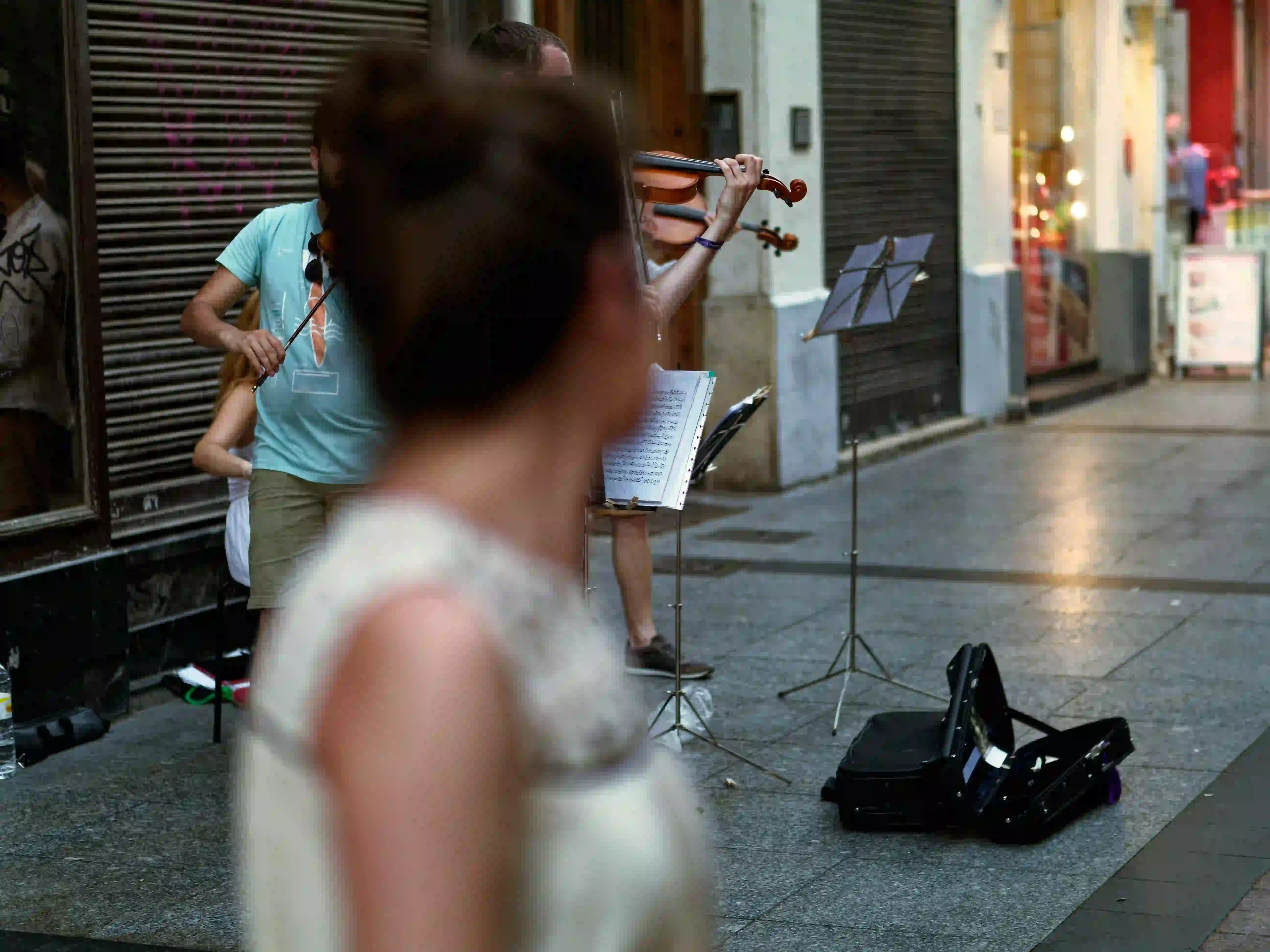
I remember standing in front of a violinist on the Naschmarkt in Vienna on a cold November afternoon. She was extraordinary — not just technically, but in the way she seemed entirely in her own world, completely indifferent to the foot traffic around her. A small crowd had gathered, maybe fifteen people, and as the piece ended there was a genuine moment of collective appreciation. People clapped. A couple of them reached into their coats.
One man next to me reached into both his coat pockets, then his jacket, with that increasingly embarrassed expression that anyone who has been caught without change recognises instantly. He gave a small shrug toward the violinist and said, loudly enough for me to hear: “I would have given you something but I only have my phone.”
She nodded and smiled, because what else do you do. He walked away. Two other people in the small crowd did the same thing in the next minute — reached into pockets, found nothing usable, left.
She told me afterward that this happened multiple times every day. Not once a week. Not occasionally. Several times, on every single performance day, across an entire year.
A sentence that keeps repeating
“I only have my phone” has become one of the most common things a street performer hears in Europe. It used to be the exception — the person who had run out to grab a coffee and left their wallet behind. It is now the norm for a substantial portion of the people walking past on any given afternoon.
The data behind this is not subtle. In Sweden, cash is now used in fewer than 10% of transactions by value, and the country is effectively cashless in day-to-day life for most residents. In the UK, the proportion of transactions made in cash dropped below 20% for the first time in 2020 and has continued to fall. In France, which historically had a stronger attachment to cash than northern European countries, the Banque de France reported a significant and sustained decline in cash usage accelerated by contactless payments during the COVID years — and that decline did not reverse when restrictions lifted. The tourists arriving in Paris or Lyon or Marseille from Germany, the Netherlands, the US or Australia are arriving from economies that have moved even further toward cashless than France itself.
For a street performer, this is not an abstract macroeconomic trend. It is the man in Vienna reaching into his empty pockets. It is the couple in Amsterdam who watched a juggler for ten minutes and clapped and smiled and walked away because neither of them could find a coin. It is the gap between genuine appreciation and actual income.
What the performers are experiencing
The shift has been gradual enough that many performers adapted without fully noticing. Those who have been working the same pitches for ten or fifteen years will tell you the nature of the audience has changed before they can put numbers on it. The people who stop look the same — curious, engaged, genuinely enjoying the performance. What is different is the moment when the hat goes around.
A street musician who has been working the Marais neighbourhood in Paris for seven years described it this way: the size of the crowd at the end of a good set has not changed much. What has changed is the proportion of that crowd who are ready to give something. In 2016, she estimated roughly six out of ten people who stopped for a full song would leave something. By 2023, she estimated it was closer to three in ten — not because people appreciated the music less, but because most of them simply had no cash on them to give.
That is a rough halving of conversion from appreciation to income, driven entirely by payment infrastructure, not quality.
Guides on free walking tours describe a nearly identical pattern. The number of guests who say “I loved it” has not changed. The number of guests who follow that sentence with “sorry, I have no cash” has increased every year for the past five years without interruption. Most of those guests would have been happy to leave the standard 10–15 € that is typical on a free walking tour — they simply had no mechanism to do it.
The three types of response
When you look at how performers have responded to this, they fall into roughly three categories.
The wait-and-see group continues doing exactly what they have always done, with a hat or tip jar and a sign pointing at it. Their reasoning, when articulated, usually involves some version of “people who want to give will figure it out” or “I don’t want to deal with technology.” This is a legitimate choice, but it carries a real cost that gets larger every year as the proportion of cashless walkers increases.
The card reader adopters — mostly guides and performers with a fixed pitch and a regular audience — bought a card reader and set it up somewhere visible. This works, but it comes with friction. A card reader handles one person at a time. Tour guides who have compared the options in detail consistently find that QR code solutions outperform card readers for groups precisely because of this queue problem. After a group performance where fifteen people want to give something simultaneously, a card reader creates a queue. Queues break the energy of a moment. People who were going to give five euros drift away while waiting for two people ahead of them to complete their transactions.
The QR code group has grown significantly in the past three years. A printed QR code on a sign, a card, or a hat solves the queue problem — any number of people can scan simultaneously, from a distance, without requiring the performer to break their setup or interact individually with each person. The guest scans, the phone opens a payment page, they pay with Apple Pay or Google Pay in two taps, and it is done. No hardware, no internet connection required at the moment of payment beyond the guest’s own phone, and no one-at-a-time bottleneck.
The tourist problem is especially acute
There is a specific dynamic worth naming separately: the international tourist as a source of tips for street performers.
A local resident in Stockholm or Amsterdam who has adapted to cashless living over the past decade still has, in theory, some cash available if they choose to carry it. They made a deliberate decision not to. An international tourist arriving from the United States, Australia, Japan or Canada has not made a decision about cash in the local currency — they have simply arrived with a foreign card and no euros in their pocket because they have not yet found a reason to get any. These guests are not ideologically opposed to cash; they are operationally without it, and they will be for the duration of their trip if they can get by without it, which in modern European cities they largely can.
This matters for performers in tourist-heavy areas because the tourist audience is often more generous when they do have a way to give. A first-time visitor to Seville who has spent the afternoon watching a flamenco busker in the old quarter often wants to contribute — they are having a genuinely memorable experience and they know it. If the performer gives them a way to do that from their phone, many of them will. If the only option is coins they do not have, they walk away with the experience and the performer gets nothing.
What the numbers actually mean
Here is the practical arithmetic. Say you perform for four hours and attract an average of forty people per hour who stop for at least thirty seconds. That is 160 people in a day. If 40% of those people — 64 people — would consider giving something but have no cash, and you have no cashless option, that is 64 people who leave with their wallets effectively closed to you.
If you introduce a QR code and capture even a third of those 64 people — say 20 transactions at an average of €5 — that is €100 per day of additional income that previously did not exist. Over a five-day week across a summer season of twenty weeks, that math produces a number that is not marginal. For most performers, it is the difference between a comfortable season and a difficult one.
The average transaction in cashless tipping tends to be cleaner than coin tips, too. People giving cash give whatever they find — a €2 coin, some small change, occasionally a note. People giving by phone tend to give round numbers: €5, €10. The social awkwardness of handing someone a precise small amount disappears when you tap a preset on a payment page. Some performers report that their average digital tip is higher than their average cash tip, partly because the preset amounts anchor people to round numbers and partly because there is less rummaging involved.
The signs that work
For performers who have adopted QR codes, the presentation matters. A QR code buried in the corner of a sign nobody is looking at gets scanned by almost nobody. The QR codes that get used consistently are large, clearly labeled with something like “Tip by phone — scan here” or “No cash? Scan to give,” and positioned at eye height or held up visibly during the moment when the hat is going around.
Some musicians attach the QR code to their instrument case, which is already the focal point for cash tippers. The case is open, the cash section is visible, and the QR code is right next to it on a small printed card. One action, two options, no choice about which payment method is legitimate.
The text next to the QR code should not require explanation or trust-building. “Scan to tip” is enough. People understand QR codes now — the pandemic made sure of that — and they will not scan something that looks suspicious, but a clearly branded tip page from a known platform removes any hesitation. For performers who also run tours, asking for a review at the same moment doubles the return from those final sixty seconds of audience attention.
The broader context
It is worth being clear that none of this is specific to any one city or any one type of performer. A flamenco guitarist in Granada, a living statue in Brussels, a free tour guide in Krakow, a street circus act in Edinburgh — all of them are dealing with the same structural shift. The population of people who stop and listen and genuinely want to show appreciation is not shrinking. The population of those people who have a coin or a note ready to give is shrinking, measurably, every year.
The performers who are adapting most successfully are not necessarily the most technically sophisticated or the most comfortable with technology. They are simply the ones who accepted, at some point, that the audience has changed and the mechanism for receiving appreciation needs to change with it. They made one practical decision — add a QR code, print it large, put it somewhere visible — and it started working immediately.
The performers who are still waiting for cash to come back are waiting for something that the data suggests is not coming back. Not in the volumes they need, not in the cities where international tourists are the primary audience, and not fast enough to make up for what is already being lost every day on every pitch across Europe.
The violinist in Vienna, for what it is worth, got a QR code printed the following week. She told me the first time someone scanned it was within the first hour of her next performance.
Frequently asked questions
What percentage of people no longer carry cash?
In countries like Sweden, the UK and France, surveys consistently show 40–60% of consumers carry little or no cash on a regular basis. In tourist hotspots where visitors rely on contactless payments, the proportion is even higher.
How much income do street performers lose due to the cashless trend?
There is no universal figure, but performers report that 30–50% of people who stop and engage do not tip because they have no cash. Offering a cashless option typically recovers a significant portion of that lost income.
What is the easiest cashless option for a street performer?
A QR code printed on a sign or card is generally the simplest — no hardware, no queue, guests pay with Apple Pay or Google Pay directly in their browser. A card reader works too but creates a one-at-a-time bottleneck.
Do people tip less when they pay cashlessly?
Not necessarily. People who already have no cash would have given nothing. Among those who do pay, contactless transactions tend to be clean round numbers — €5, €10 — which can be comparable to or higher than coin tips.