The psychology of tipping: why people give (or don't)
What behavioral science says about why people tip, how anchoring and social norms work, and what tour guides and street performers can do about it.

A guide I know in Seville has been running the same walking tour for four years. Same route, same stops, same stories, same script down to the jokes. She knows her material so well she could deliver it in her sleep. And for years she thought of her tips as essentially random — good day, bad day, something you could not really predict or control.
Then she started writing them down.
After about six weeks, a pattern emerged that genuinely unsettled her. On her best days, she was averaging €18 per person. On her worst, €8. The gap was not occasional — it was consistent, week after week. Same city, same tour, same guide. But something was creating a €10-per-person difference in her income, and for a while she had no idea what it was.
She eventually found the answer, and it was not what she expected. On the good days, she had been in a particularly good mood — the kind that is contagious. The group had laughed a lot in the first fifteen minutes. That early connection had set an emotional tone that carried through the whole two hours. By the time she reached the closing speech, the group was not just satisfied. They were happy. And happy people tip more.
This was not a coincidence. It was behavioral science in action.
Why people tip at all
Tipping is not a rational economic behavior. If it were purely rational, people would stop tipping the moment they were out of sight of the guide — because the incentive to maintain a relationship is gone once the tour is over. Yet most people who plan to tip do so anyway. Research on tipping behavior, including foundational work by Cornell University’s Center for Hospitality Research, shows that tips correlate much more strongly with emotional factors than with objective measures of service quality. Understanding this helps explain why so many cashless tours leave money on the table — it is not the payment method that is the problem, it is the emotional disconnect.
People tip, at root, because of social obligation. They have received something — an experience, a performance, a narrative — and they feel an asymmetry that needs to be resolved. The coin in the jar is a way of restoring balance. Understanding what drives that sense of obligation is the key to understanding what actually affects tips.
The reciprocity principle
The psychologist Robert Cialdini spent years documenting what he called the reciprocity principle: humans are deeply, almost compulsively, driven to return gifts and favors. When someone does something for us, we feel obligated to do something back. This is not a weakness — it is a cornerstone of social cooperation. But it is also highly exploitable, and it operates in ways we are often not consciously aware of.
For guides and performers, the implication is direct: the experience itself creates the obligation. A genuinely excellent tour does not just satisfy guests — it puts them in your debt. They enjoyed something they did not pay for, or paid very little for, and the psychological pressure to reciprocate is real and measurable. Research in restaurant settings shows that small acts of unexpected generosity — bringing a small gift, adding an unrequested extra — significantly increase tips, far more than the monetary value of the gesture would predict. The mechanism is not transactional. It is social.
The practical takeaway: the quality of the experience is not just nice to have — it is the primary driver of the financial outcome. Everything else discussed in this article is a marginal improvement on top of the baseline set by how good the experience actually was.
Social norms and the first tipper
One of the most consistent findings in tipping research is the social norm effect: people look at what others are doing before deciding what to do themselves. This is especially powerful in a group setting, where every person is aware that they are being observed by people they do not know and may briefly care about impressing.
When guests are deciding whether to tip, and how much, they are not calculating in isolation. They are watching. They are waiting to see what other people do. And the first person to tip sets the reference point for everyone else.
This is why the first tipper matters so much — and why acknowledging them visibly and warmly creates a cascade. When you thank the first person who reaches for their wallet, not just with a quick nod but with a genuine, brief moment of attention — “thank you, really, it means a lot” — several things happen at once. The tipper feels seen and validated. The rest of the group sees that tipping produces a positive social reaction. And the norm is established: this is what we do here, at the end of this tour, with this guide.
Suggested amounts work through the same mechanism. When you say “most people give €10-15,” you are not just anchoring a number — you are invoking social proof. You are telling guests what the norm is. And humans, when uncertain, defer to norms. Cornell research on restaurant tipping found that server suggestions and descriptive social norms (“this is what people typically do”) have a measurable and consistent upward effect on tip amounts. This is closely related to how to ask for tips without creating awkwardness — framing the request as a description of what others do removes the social discomfort for everyone.
Anchoring: why naming a number changes everything
Behavioral economics has a well-documented phenomenon called anchoring: when people are uncertain about a quantity, they latch onto any number they encounter first and use it as a reference point, even if that number is entirely arbitrary. In one famous study, people who were first shown a high random number gave higher estimates for completely unrelated quantities than people who had seen a low number. The anchor does not need to be relevant to exercise influence.
For tipping, this is enormously consequential. A guest who has just finished a two-hour tour and is trying to decide what to give has no strong prior on what is appropriate. They are genuinely uncertain. If you give them an anchor — “most guests give around €10-15” — they will calibrate around it. If you give them nothing, they will default to whatever instinct feels comfortable, which is almost always on the low end.
Guides who do not name a number are not being more ethical or less pushy. They are simply leaving money on the table — money that guests would have been perfectly happy to give if they had known what was normal.
The framing matters. “Most guests give €10-15” is social proof — it describes what others do, which is comfortable to hear. “The suggested tip is €15” sounds like an invoice. “Whatever you can” sounds desperate. The descriptive framing — “most people,” “guests typically,” “a lot of people give” — consistently outperforms both directive and open-ended framings.
Mood, emotional state, and the first ten minutes
The guide in Seville had found something real. Research on what psychologists call positive affect — basically, how happy and connected someone feels — shows that it has a measurable effect on generosity. Happy people donate more to charity, give larger tips in restaurants, and are more likely to comply with requests. The mechanism is not mysterious: positive emotions reduce the perceived cost of giving and increase feelings of goodwill toward others.
For tour guides, the implication is that the first ten minutes of the tour set the emotional register for everything that follows. A group that laughs early bonds early. A group that bonds early is emotionally warm by the end. A group that is emotionally warm at the end tips more generously.
This is not about being artificially cheerful. Forced enthusiasm reads as exactly that and produces the opposite effect. It is about genuinely investing in the first few minutes — the welcome, the first joke, the first surprising fact, the first moment of real human connection. If the opening is flat, the whole tour runs at a lower emotional temperature, and no amount of excellent historical content will fully recover it.
Group dynamics: small groups, peer pressure, and the herd
Groups tip differently than individuals, and larger groups tip differently than smaller ones. Several dynamics are at work simultaneously.
First, in larger groups there is a diffusion of responsibility: each person feels less individually obligated because there are more people to share the burden. In a group of four, not tipping is conspicuous. In a group of twenty-five, it is easy to assume someone else will cover it. This partly explains why small groups often tip higher per person — the social pressure is more concentrated.
Second, larger groups take longer to process the tipping moment, which means more time for the emotional peak to fade. The longer guests have to think about dinner, their sore feet, and where they left their sunglasses, the smaller the tips tend to be.
Third, every group has a few natural leaders whose behavior others follow. When one of these people is clearly engaged and generous, it has a disproportionate effect on the group. When they leave early, or are visibly unimpressed, the ripple runs the other way.
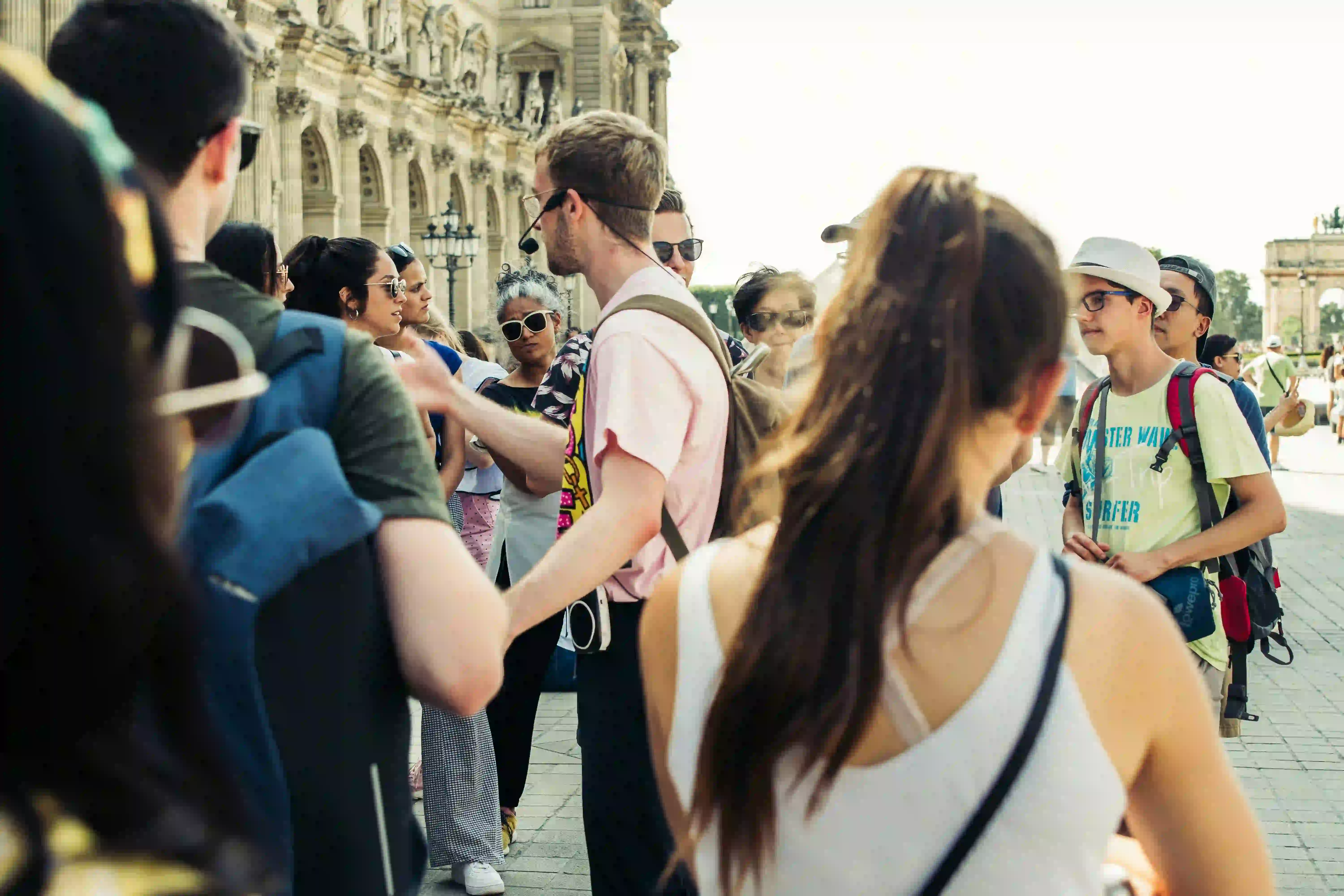
The practical implication: with large groups, create smaller social clusters. Break people into conversation pairs during the walk. Address specific people by name when you can. Make the group feel like a collection of individuals you are personally engaged with, not an anonymous mass you are lecturing. Small-group intimacy within a large-group structure maintains the social pressure that drives generosity.
The pain of payment: cash vs. cashless
Research in behavioral economics on what is called the pain of payment shows that spending money is genuinely unpleasant — it activates the same neural regions as physical pain, albeit mildly. Crucially, this pain is greater when payment is more concrete and visible. Handing over paper notes hurts more than swiping a card, because the card feels less real. This is part of why people spend more on credit cards than cash.
For tipping, the consequences are more nuanced than they might appear. Cash tips feel more significant to the giver, which can actually reduce the amount. The person rummaging for coins is making a series of micro-decisions about each denomination, and each one involves a small amount of psychological pain. Card or phone payments short-circuit this process. People tap, see a round number, and approve it without the same visceral engagement.
The pre-commitment effect is also relevant here. When you mention at the start of the tour that there will be a tip ask at the end, guests have time to mentally allocate money — to decide, ahead of time, that they are going to give €15. This pre-commitment is much more durable than an in-the-moment decision made under social pressure. The opening mention of tips is not just courtesy. It is giving guests permission to commit before the discomfort of the moment arrives.
Timing: the peak and the ask
There is a narrow window after the emotional peak of an experience when generosity is at its highest. This is the moment when the group is most moved, most connected, most aware of the value of what they have just experienced. Tips taken at this moment are consistently higher than tips taken ten or fifteen minutes later when guests have already mentally checked out. The practical craft of how to end a free tour is essentially an exercise in locating and exploiting this window before it closes.
This window closes fast. The moment guests start thinking about what they are doing next — dinner, the metro, whether the museum closes at five — the emotional peak fades, and with it the impulse to give generously. A guide who does their closing speech while guests are still buzzing from the best story of the tour earns more than one who waits for everyone to drift back together, by which point the energy is gone.
Identify your peak moment and position your closing immediately after it. Do not trail off, do not add one more story, do not wind down gradually. Hit the peak, pause for it to land, then go directly into your closing speech while the feeling is still in the room.
What you can and cannot control
Here is the honest version of all of this: the biggest variable in your tips is you. Your personality, your energy, your genuine enthusiasm for the material and the group. All the techniques covered in this article — anchoring, timing, social proof, pre-commitment — are real effects supported by real research. They also all operate at the margins. For guides who want to go further, proven tactics to increase tip amounts covers the practical implementation side of what the behavioral science described here only frames.
A guide who is going through the motions, bored of her own script, will not turn a thin tip day into a good one by naming the right anchor number. A guide who is genuinely lit up about what she is doing, who makes people feel like they are in on a secret, who creates real emotional resonance — that guide will earn well even if she makes every technical mistake in the book.
The behavioral science is useful because it tells you what to do with the energy you already have. It gives you structure for converting a good performance into a better financial outcome. But it cannot manufacture the performance. That part is still on you.
The good news — and this was ultimately the lesson the Seville guide took from her notebook — is that the energy is not mysterious. It is a practice. It is the choice, tour by tour, to bring your full attention and genuine curiosity to the group in front of you rather than the version of them you guided last Tuesday. When that choice becomes a habit, the tips take care of themselves.
Frequently asked questions
Why do people tip more on some days than others?
The biggest factors are the emotional state of the group (happy, connected groups tip more) and social dynamics (people look at what others are doing before deciding). A strong opening that creates connection and laughter sets the register for the whole experience.
Does suggesting a tip amount actually increase tips?
Yes, consistently. Research on anchoring shows that people use a reference point to calibrate their response. Without one, they default to too little or nothing. Mentioning a specific range ("most people give €10–15") increases average tips without coercion.
Do people tip less when paying by card?
Not necessarily. The "pain of payment" literature suggests cash feels more real than card, which can reduce cash tips. But people who pay cashlessly tend to give clean round numbers (€10, €15) which are comparable to or higher than the coins people would have fumbled with. The net effect is approximately neutral to positive.
What single thing has the biggest impact on tips?
The performer's energy and the emotional quality of the experience. All the techniques around timing, anchoring and social proof are marginal improvements. A mediocre experience with great technique still earns less than an exceptional experience with no technique at all.