Where to place your QR code to get more tips
The placement, angle, height and format that make QR codes actually get scanned — with specific advice for musicians, tour guides and street performers.

A street magician I know who works Temple Bar in Dublin had a QR code problem he could not diagnose. He had done everything right: dedicated platform, good profile photo, matte lamination. The code itself was fine. But his scan rate was almost zero. After three weeks of barely any phone tips, he asked a friend to film one of his end-of-show moments from the back of the crowd.
When he watched the video back, it took him about four seconds to see it. He was holding the card at hip height, angled at roughly twenty degrees from vertical, with his back to the afternoon sun. The code was in shadow — his own body was casting it. Even when he moved, it was pointing slightly at the ground rather than at the audience. Nobody in the crowd could have scanned it without crouching and positioning their phone at an awkward angle pointing upward.
He made two changes. He moved the card to chest height. He turned to face away from the sun, so the light fell on the card rather than behind it. That was all. His scan rate went from almost zero to around 30% of the crowd tipping by phone within a week.
The code was never the problem. The placement was.
Height and angle: the two variables that matter most
A smartphone camera needs three things to scan a QR code reliably: the code must be large enough in the frame, it must be well lit without glare, and it must be roughly perpendicular to the camera’s line of sight. All three of those conditions are affected by where and how you hold or display your code.
Height: chest height is the target. When you are actively holding the code during your tip ask, chest height places the code at approximately the right distance for most people to scan without having to stretch, crouch, or angle their phone awkwardly. Hip height is too low — it requires people to point their camera downward at an angle, which reduces the effective scanning distance and puts the code in shadow more often than not. Above shoulder height is too high and creates a backward lean for the scanner. If you are still deciding which platform to generate your code from, a comparison of cashless tipping apps covers what to look for before you commit.
For static displays — a code propped against a case or on a stand rather than held — aim for a height between 90cm and 120cm from the ground. This is roughly the range where an adult’s phone camera sits naturally when they hold their phone at a relaxed scanning angle. Below 80cm and most adults have to crouch. Above 130cm and they have to hold their phone up uncomfortably.
Angle: parallel to the scanner’s phone. The code should be as close to perpendicular to the direction the scanner is approaching from as possible. This means facing your audience directly, not angled to one side. A QR code at 30 degrees from the camera’s perpendicular can fail to scan; at 45 degrees it will almost always fail. If your display stand is at an angle, adjust it before the performance.
Light: face away from direct sun. Avoid having direct sunlight falling on a glossy surface — it will cause a reflection that washes out part of the code. If you are using matte lamination, direct light is actually fine. The problem is when the light source is behind you and your body or surroundings cast irregular shadows across the code. The simplest solution is to position yourself so the light source is behind the audience and falls on the front of the code.
Physical formats by performer type
There is no single format that works for every situation. The right physical display depends on your performance style, your typical audience configuration, and whether you are stationary or moving.
Street musicians
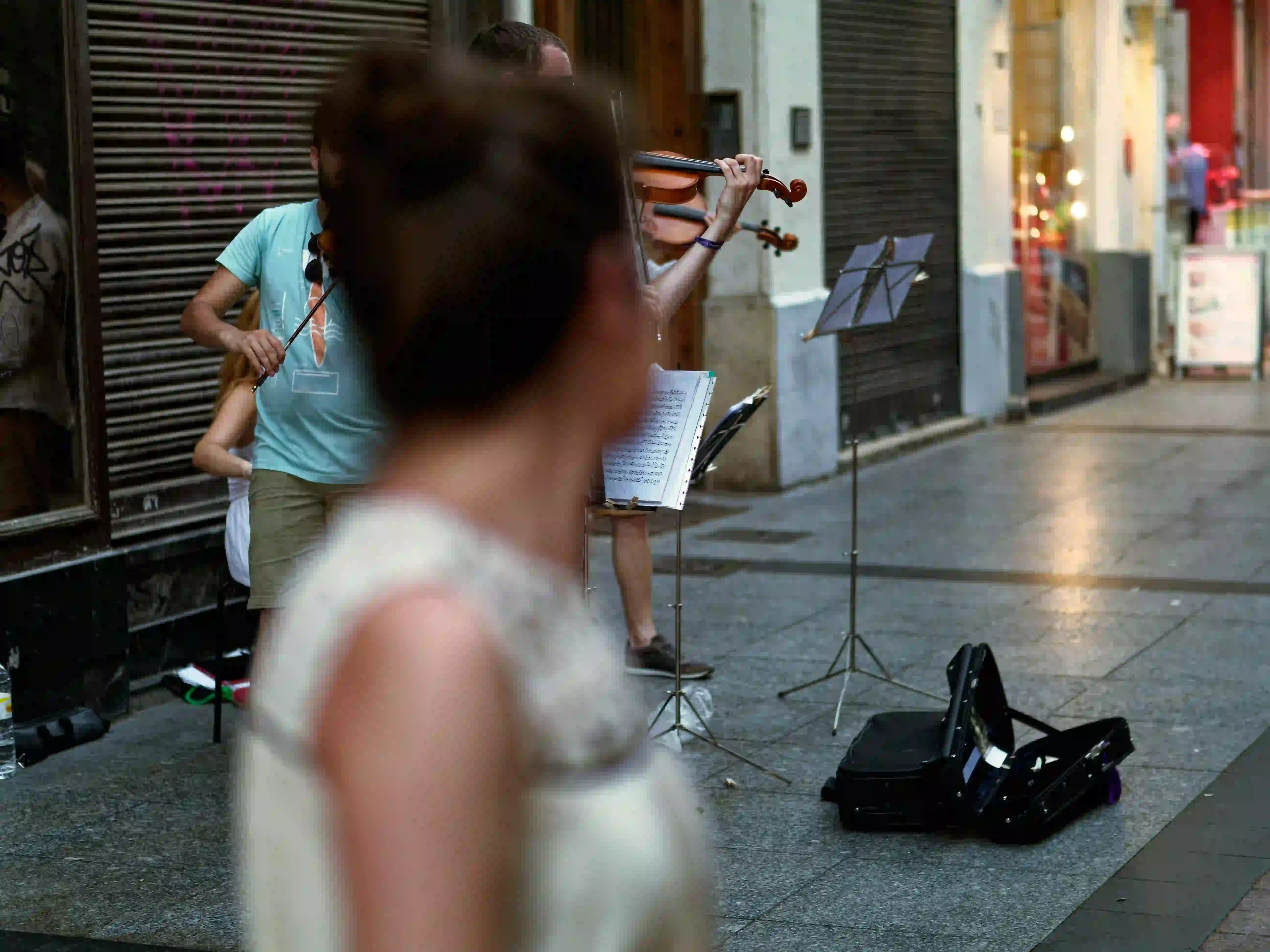
For a musician playing in a fixed pitch — a guitarist, a violinist, a saxophonist — the standard setup is a laminated card propped against the open instrument case. The case is already the natural focus of attention for tipping (people look at it to figure out where to put cash), so the QR code sits alongside the cash collection in a way that feels natural rather than imposed.
The card propped against the case should be at least A5 in size (14.8×21cm), positioned vertically and leaned at roughly 70–80 degrees from horizontal — upright enough to be read face-on but not so vertical that it falls over. Some musicians attach a small piece of velcro or a clip to keep it stable in wind. A piece of BluTack on the back works too.
For the active tip ask — when you pause between sets and specifically invite tips — hold an additional card at chest height rather than pointing to the case. The motion of picking it up signals to the audience that you are inviting them to do something, which creates more engagement than a static display they may have been ignoring.
Free tour guides
A guide’s main tip moment is the closing speech, and the QR code should be deployed actively during that moment rather than left tucked away until needed. The standard format is an A5 laminated card held up at chest height while you deliver your closing lines. Hold it with the face toward the group, not angled toward you to check if you are holding it straight. For the full closing speech technique — how to structure those final minutes so the QR code moment lands well — how to end a free tour covers this in detail.
Many guides also carry a second, smaller version — a credit-card-sized laminate on a lanyard or in a badge holder — which is useful for one-on-one moments when a guest approaches you individually after the group has dispersed. The big card is for the group. The small card is for the individual conversation.
Some guides have their QR code printed on the back of their name badge or guide credential. This works well as a secondary option but not as the primary display — it is too small and too easily overlooked. Use it as a fallback for one-on-one interactions.
Street magicians and circus performers
A magician or circus act typically has a larger crowd and a more defined end-of-show collection moment. The formats that work here are different from a musician’s.
The most effective setup is a sign worn on the hat or fixed to a collection vessel — the hat, the bucket, or whatever you use to circulate during collection. When you circulate through the crowd collecting from individuals, the QR code is right there at eye level for each person you approach, which removes the step of them having to look around for it.
For larger crowds, a separate announcement board at the edge of the pitch — an A4 or A3 sign on a small stand — serves the part of the crowd that cannot easily reach you during collection. Print the URL below the QR code on this sign so that anyone who cannot scan it from distance can still type it in.
If you have a helper or assistant, giving them a handheld A5 card to circulate with during collection is one of the most effective formats of all. The helper can approach individuals directly, hold the card at the right height and angle for that specific person, and make eye contact while they scan. This removes all the passive display problems in one move.
Living statues and silent performers
A silent performer cannot verbally invite people to scan, which means the visual display does the entire job. This requires a larger and more prominent format than other performance types.
The standard setup is a sign at the base of the statue platform — positioned at roughly 100cm height, facing the direction of highest foot traffic, in A4 or A3 size. The sign should include a very short text prompt alongside the code: something like “Tip with your phone” in two or three languages if you perform in a tourist area. Do not assume people know what a QR code is or what to do with it.
If budget allows, a helper circulating with a handheld card will always outperform a static base sign. The proactive offer makes a significant difference for a performer who cannot speak.
Lighting considerations
Outdoor performance in bright sunlight is the toughest environment for QR code scanning, and the problems vary by time of day.
In direct midday sun, the primary problem is glare from glossy lamination. The solution is matte lamination, full stop. A matte surface diffuses the light rather than reflecting it. If you already have a glossy laminated card, tilt it slightly away from the direct light source until the reflection disappears — this usually means angling it forward at the top by 10–15 degrees.
In late afternoon sun at a low angle, the problem shifts to long shadows. Your body, a nearby building, or even a large crowd can cast a shadow that falls across the code at exactly the wrong moment. Monitor this during performances that start before sunset — it can change within twenty minutes.
Indoor dim venues — a bar, a restaurant, a low-lit theatre — create the opposite problem. The code is visible but the phone camera may struggle to focus in low light. In this situation, a larger print size helps because it gives the camera more pixels to work with. An A4 print in a dimly lit venue will scan more reliably than an A5. You can also invite the guest to turn up their screen brightness before they try, which helps when you show them the code on your own phone.
Nighttime performance on streets with mixed artificial lighting — some areas bright, some in shadow — is unpredictable. The safest approach is to hold the code close to the nearest stable light source, which usually means under a streetlamp rather than in the area between lamps. A phone torch shone briefly at the code while the guest scans also helps.
Fallback for when scanning fails
Some guests will try and fail, and how you handle that moment affects whether they tip at all.
The single most effective fallback is printing the direct URL below the QR code on every sign and card. Keep the URL short — if your tipping platform offers a short custom URL (wavetips.com/yourname rather than a long string of characters), use it. A guest who cannot scan can type this in their browser in under ten seconds. Many people who fail to scan will do this if given the option. Understanding how QR code tipping works from the guest’s perspective also helps you explain the process confidently when someone hesitates.
The second fallback is showing them the code on your own phone screen. A phone screen is backlit and higher contrast than a printed card, which makes it significantly easier to scan in difficult lighting conditions. Pull up the QR code in your browser or from your camera roll, increase your screen brightness, and hold it out to them. This takes about ten seconds and converts almost every failed scan into a successful one.
Do not apologise at length or spend time troubleshooting their phone settings. Keep it practical and quick. If someone is unable to scan and there is a queue of people behind them, move on rather than holding up the whole moment.
One code, multiple formats
Some performers have the instinct to create different QR codes for different positions — a separate code for the stand, a separate code for the handheld card, a separate code they send out on social media. Resist this.
One code in multiple physical formats is almost always better than multiple codes. Multiple codes require you to track which code is getting scans, add complexity to your setup, and create the risk that a guest sees two different codes on two different signs and wonders which one is correct.
The right approach is: one code, designed and saved at high resolution, printed in the formats you need — A5 for the stand, credit-card size for your wallet, A4 for a more prominent display — and the same code everywhere. When you need to update your tipping profile, you update it once and every format still works.
The Dublin magician now carries three things: an A5 laminated sign he proches on a stand at the edge of his pitch during the collection phase; a smaller card he holds up during his closing speech; and his phone, which he uses as a last resort for anyone who can’t get the printed version to scan. He turned his back to the sun. He moved the card to chest height. Thirty percent of his crowd tips by phone.
None of it was complicated. It just required watching what was actually happening.
Frequently asked questions
Where should a street musician place their QR code?
The most effective position is propped against the instrument case or on a small stand at a height where passing pedestrians can see it without bending down. For the tip ask at the end of a set, hold it at chest height facing the audience while you speak.
Why aren't people scanning my QR code?
The most common causes are: the code is too small to scan from a distance, there is glare from direct sunlight, the code is at an awkward angle, or people don't notice it because it blends into the background. Try a larger print size (minimum 10×10cm outdoors), matte lamination, and a contrasting border around the code.
Should I have a different QR code for different positions?
Generally one code is simpler and better. Multiple codes create confusion and maintenance issues. Use one code but multiple physical formats — a large sign, a smaller handheld card, and perhaps a small sticker on your instrument case.
How do I handle it when someone can't get the QR code to scan?
Have the direct URL printed on the sign below the code so they can type it in. Alternatively, offer to open your own phone and let them scan the code from your screen — the screen brightness makes it easier to scan than a printed version.